

Thank you! Your submission has been received!
Oops! Something went wrong while submitting the form.







To every local journalist who loves their work, we have good and, depending on how you look at it, bad news. We’ll start with the bad:
AI is a giant upheaval. It means changing newsroom practices you’ve probably grown accustomed to, even if you never want to touch the technology.
Now the good news:
Nothing about your newsroom’s mission changes. You will still give people information that helps them live better lives, build community and use your expertise for the greater good.
But continuing to do that for many years to come requires this conceit: AI has changed the way people get information, and that requires journalists to rethink how they produce their work, connect with audiences and explain (and monetize) their value. Every newsroom needs an AI strategy, whether you use the technology or not. For independent local newsrooms, that strategy doesn’t have to start with prompts, code or new tools. It starts with your mission and your value to your community.
At Indiegraf, we sum up the strategy this way: Independent local newsrooms need to build context, connection and community. You can do this with or without AI assisting you in newsroom work and with or without bots blocked. But if you want to reach a human audience, focusing on these three values is key.
The time to start on the strategy is now. Already, AI is creating an additional layer that journalists need to break through on some of the main channels they use to reach news consumers. Take traditional search: Traffic to small publishers from this referral source fell 60% between January 2024 and January 2026, according to data from Chartbeat. Meanwhile, online bot traffic has overtaken human traffic, according to Cloudflare, one of the largest internet security and infrastructure providers.
That means your first, and sometimes only, reader is probably a bot. LLMs and AI agents are mediators between you and your audience. To reach the actual people you want to reach, you have to bypass or break through them. And if you want to make money from them, that’s an option too. But all of these options—or what Indiegraf prefers to think of as opportunities—require you to rethink business as usual.
I’ll start with a concrete example of the kind of editorial shift this requires: When the Reuters Institute asked more than 250 digital leaders worldwide how journalists can compete in the era of AI, they ranked service journalism as the lowest priority. Why? Because many action-oriented questions based on existing information can easily be summarized by AI. Second-to-last on the list was “general news,” or information lots of people already have or can easily get (and AI can easily summarize).
The internet democratized publishing, replacing newspapers and newscasts as necessary channels for getting basic information about the world around you. But people still needed journalists to give them a coherent summary of what was happening in the world. Now AI can more or less do that, however imperfectly, and the number of people who are using chatbots for news is growing, according to the latest data from the Reuters Institute.
This is where we see opportunity instead of doom and gloom: There were some newsroom tasks—such as writing the infamous “What time is the Super Bowl?” story—that few, if anyone, saw as core to their mission of being a journalist. It was a business imperative. But where traditional search encouraged scale, and AI-mediated landscape encourages expertise and trust. As Eli Pariser, the author of “The Filter Bubble,” put it, we’re moving from an “attention economy” to a “trust economy.” We love that framework, we’re seeing evidence that AI-propagated misinformation increases the economic value of trusted news sources.
And in the trust economy, business incentives align more closely with journalism’s mission. When we surveyed Indiegraf publishers about AI, a majority indicated they were excited to emphasize journalistic expertise, deepen relationships with their audience and emphasize that their work is done by humans, for humans. Here’s how to put that into practice:
Another pillar of Indiegraf’s AI strategy: Any AI tools you use for editorial work should free you up to accomplish something on the list above and/or help you serve your audience and grow your revenue.
One of our favorite examples of a newsroom in the Indiegraf network that checks these boxes is the Palm Springs Post: Founder Mark Talkington has built a profitable newsroom where AI agents help summarize complex documents and transcribe and write stories about government meetings, but the final output is always checked by a human editor. This has freed up journalists to focus on more complex investigative stories—and it gives them time to add personal touches to the daily newsletter, such as these notes at the end:
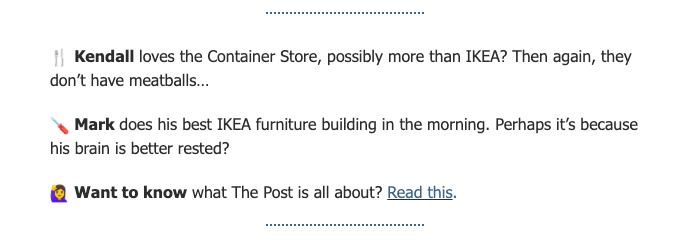
The Palm Springs Post is transparent about AI use: You can find the newsroom’s disclosure on the “About” page, where you’ll also find prominent pictures of Mark and editor Kendall Balchan.
We understand a lot of this is easier said than done, and we know that local newsrooms are facing a polycrisis right now. That’s why we’re building Indiegraf OS to help journalists succeed in the trust economy: Our tools are purpose-built for audience engagement, trust and financial sustainability. And we’re just getting started: Whether you want to use AI to make your journalism more accessible, create more efficient editorial or advertising workflows or translate your archives into structured data, our technology and our people are here to help. You can run away from AI, you can run toward it, or you can do both at the same time. But you can’t do nothing. We’re your partner in this journey, whichever path you take.

Indiegraf is the operating system for independent local media.