

Thank you! Your submission has been received!
Oops! Something went wrong while submitting the form.



As you get ready to launch your newsletter, there is plenty to get excited about. Your mind may be drifting to art direction, image selection and the potential for audience growth. But an important aspect to include in planning any newsletter strategy is email compliance.
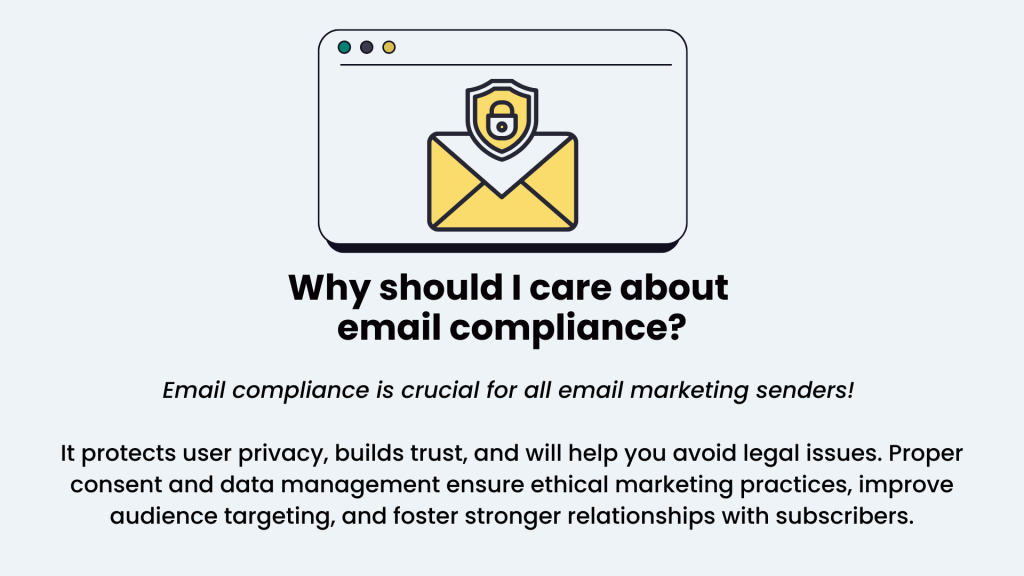
Email compliance is a set of email marketing regulations that are commonly known as anti-spam laws. This type of legislation regulates email communications between businesses or organizations, and their consumers. The role of email marketing compliance is to protect user privacy and data. It also ensures that users remain in control of who is allowed to send them marketing communications and who is not.
All newsletters, no matter their content, need to follow the same rules and regulations as any marketing email. Some publishers may consider newsletters “editorial” products which are separate from marketing emails. However, newsletter compliance is not a separate standard under email compliance laws.
Not complying with email marketing regulations can result in hefty fines and a hit to your publication’s reputation. In the United States, email compliance is regulated under CAN-SPAM Act of 2003. In Canada, email marketing regulations are set by Canada's anti-spam legislation (CASL).
Some jurisdictions outside of North America hold far more rigid email compliance regulations such as Europe’s General Data Protection Requirement (GDPR). Individuals and organizations holding the personal data of a resident are still required to comply with the GDPR. Therefore, it's best to set up your newsletter so it complies with the strictest regulations.
It is best to review a comprehensive summary of CAN-SPAM and CASL. You may also choose to seek independent legal advice as you scale your email marketing operations. Generally, both legislations include:
Almost all email compliance standards start with an email consent policy. This is the requirement that users must give you implied or explicit consent to send them emails. This begins when an individual grants you that permission by providing their email address or checking a box.
Some examples include:
Once consent is received, your relationship with the subscriber is regulated by the relevant email compliance laws where your reader resides. This includes what type of emails you’re allowed to send and how you are required to handle your readers’ private information.
In CASL, there are two forms of consent that can be relied on to send commercial electronic messages (CEMs): express (also known as explicit) or implied consent. Express consent means that someone has clearly and positively agreed to receive a CEM in writing or orally. Implied consent can be relied on under certain circumstances, as outlined by the legislation. Here are examples of each type of consent.
Express consent must be obtained through an opt-in method, such as:
Implied consent may exist under certain conditions:
Any method in which you explicitly ask for a user’s email for the purposes of receiving email communications is a compliant collection method. This consent should be recorded and documented in all circumstances.
Some email service providers (ESPs) have a “non-subscribed” category, where contacts with implied consent are recorded versus a “subscribed” category, where contacts with explicit consent are kept. Other ESPs don't have this functionality, so you will need to keep track of who has given implied or explicit consent in another way, like using tags.
It’s important to keep track of who has unsubscribed from your list and not send out emails to those individuals. Without a service that automates this process, your subscription list will need to be managed manually and carefully to avoid errors and ensure you remain compliant.
Subscriber database mismanagement is by far one of the most common email compliance mistakes. Not ensuring an automated or carefully planned system is in place to track who has given consent, and who has not, can lead to many headaches.
Common pitfalls also arise when emails that are collected for one purpose (such as signing up for a newsletter list) are used for another purpose (such as marketing emails). For example, if your publication requires that readers use their email to create an account to access content on your site, it is strongly not recommended to use this registration database for marketing automatically.
Purchasing, “borrowing,” harvesting or stealing email lists is extremely risky and in many cases illegal. Taking any of these actions can lead to steep penalties and fines under email compliance regulations.
Opt-in email marketing describes a permission-based email marketing process that maintains ongoing and active consent from readers.
Allowing readers to “opt-out” is a cornerstone of “opt-in” email marketing regulation and email compliance standards. This means that all promotional emails include an easy way to unsubscribe somewhere in the email. The link should be visible and easy for the reader to locate. Once someone has “opted out,” this request must be promptly honored; Sending any further emails to that individual may result in fines under relevant email complaint laws.

Complying with email consent requirements is the best way to show respect for readers’ privacy, data and preferences. It is also a good way to understand who your target audience is, so you can better serve your readers. If readers have willingly consented to receive your newsletter, it means that they support the publication’s mission and want to engage with its content.
Fail to meet email compliance regulations and you run the risk of frustrating and confusing readers. While you may not necessarily be hit with a fine each time you receive a spam complaint, it can hurt email deliverability if you end up on a blocklist. Unengaged email contacts will also bring down your open rate. Finally, you risk permanent reputational damage with the very readers you’re looking to connect with.
Read more 📖 “Email newsletters 101 | A complete guide for independent publishers and journalists” to find out how to craft effective email newsletters that boost audience engagement and revenue growth.
Need guidance on email best practices? Reach out to Indiegraf's experts today. We'll help you create a compliant, effective email strategy that engages your readers.

Indiegraf is the operating system for independent local media.