
Thank you! Your submission has been received!
Oops! Something went wrong while submitting the form.



Here's an uncomfortable truth for any newsroom: your readers probably already think you're using AI. Whether you are or not.
That was the starting point for a recent Indiegraf webinar with Laura Davis, Indiegraf's Entrepreneur in Residence for AI, and Lynn Walsh, Assistant Director at Trusting News. Their argument was simple. If your community assumes AI is in your workflow, staying quiet doesn't help you build trust. A clear policy does.
The good news is that getting one published is far easier than people think. You don't need a big team or a six-month committee process. You need to answer a few honest questions and put the answers somewhere people can find them.
This piece walks through what the research says, what real newsroom policies look like, and how to draft your own.
A Reuters survey across six countries found that most people believe journalists use AI always or often. A University of Minnesota study found that more than a third of Americans believe journalists use AI to write stories at least sometimes, and only 8% think it never happens.
As Davis put it, the perception exists in the aggregate no matter what any single newsroom is actually doing. With a policy, you're not introducing the idea of AI to your audience, but correcting it with the facts about how you use it — or don't.
"Whether you're using AI or not, whatever you're doing with it, your audience probably assumes that you are."
Trusting News has spent three years asking news consumers a single question: how can journalists use AI without losing trust, and maybe even build it?
The answer comes back consistently. People want transparency, and they want it strongly.
In other words, outright opposition is shrinking, but the demand for guardrails is growing. Most of the audience is landing in the same place: it's fine to use AI, as long as you're honest about it and you have rules.
A separate study of around 2,000 people in Chile reinforced the point. Researchers asked participants to compare how different newsrooms handled and disclosed AI. Two things consistently raised perceived credibility: human oversight and disclosure of use.
Davis and Walsh break the work into two pieces.
You need both. Most people will never stumble onto your policy page, so the disclosure on the story is what reaches them in the moment.
When researchers tested in-story disclosures, the ones that linked back to a fuller AI policy performed better. People reacted more positively when "we used AI here" came with "and here's our thinking on all of it."
A useful AI policy answers three questions your audience is actually asking:
Underneath those, readers want to know why you're using it, how you're keeping the work accurate, and whether a human is still involved. That last point matters most. Across the research, people are simply not comfortable with content created solely by AI with no human touching it before it goes live. The "human in the loop" is the thing they're checking for.
The webinar walked through several real examples worth borrowing from.
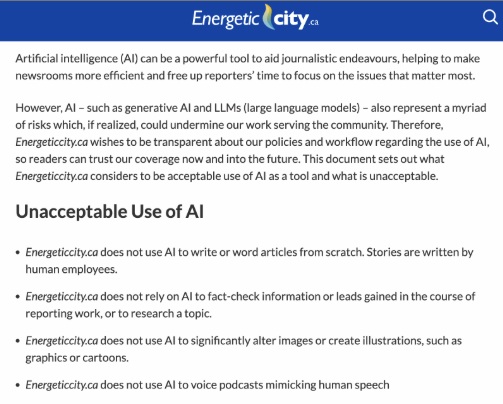
Energeticcity.ca, an Indiegraf publisher, keeps its AI policy linked right from the About Us menu, clearly labeled. It opens by acknowledging the risks of AI, lays out acceptable and unacceptable uses, and states that the newsroom retains ultimate accountability for anything it publishes.
That accountability line does a lot of quiet work. It tells readers a person stands behind the output.
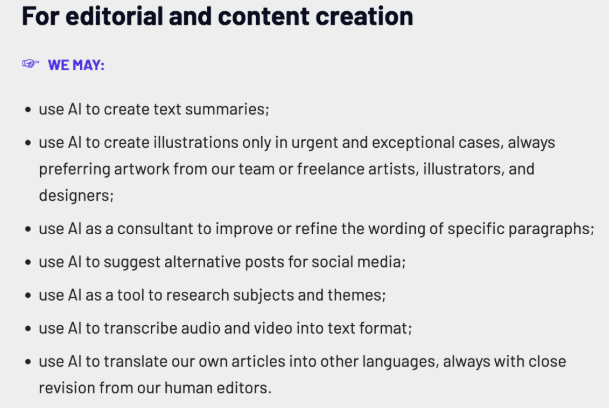
Nucleo, a Brazilian newsroom that has leaned into AI early, including some image generation, structures its policy as a simple FAQ. A short intro explains why they use AI and invites feedback, then three questions:
The FAQ format is easy to read, answers the questions people care about most, and stays flexible. If readers start asking about, say, environmental impact, you add a question. It becomes a living document rather than a frozen legal statement.
At the bottom of relevant stories, USA Today notes that the piece was created by a named reporter with the assistance of AI, that journalists were involved in every step of gathering, reviewing, editing, and publishing, and links to the full policy. That single block hits every point the research says audiences want: who, what, human oversight, and where to learn more.

This is the part many newsrooms miss. If you don't use AI, say so, loudly.
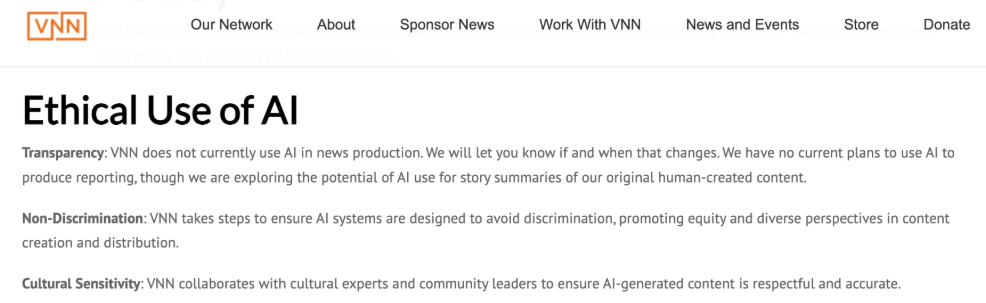
VNN, a local newsroom serving Indigenous communities in Oklahoma, states plainly that it does not currently use AI in news production, has no current plans to, and will tell readers if that changes. As Walsh noted, that kind of statement shows the newsroom knows the technology exists and made a deliberate choice. You should get credit for that thoughtfulness, and the research suggests there's a real appetite for "by humans, for humans."
"Don't let perfection stop you from getting something out there. You can always improve it and go deeper as time goes on."
During the session, we built an AI policy in real time. Katherine Stanley Obando of El Colectivo 506, a bilingual solutions-journalism organization in Costa Rica, volunteered to work through the Trusting News worksheet.
Her newsroom's situation is a good stand-in for a lot of small, mission-driven outlets:
Stanley Obando also described a twist on AI use. Her team built a chatbot that helps freelancers strengthen solutions-journalism pitches against four pillars: response, evidence, insights, and limitations. Rather than receiving obviously ChatGPT-drafted pitches, they channel that energy into a tool they control and trust. The bot pushes journalists to think harder, not to write for them.
This is the question that makes editors nervous, and the research is honest about it.
When newsrooms added in-story disclosures, some did see a slight drop in trust once readers learned AI was involved. But the size of that effect varied a lot by audience. International newsrooms, including those in Switzerland and Brazil, saw little or no decrease compared to US newsrooms.
The conclusion from Trusting News is still firm: disclose anyway. The backlash from getting caught not disclosing is worse than the modest cost of being upfront. Know your audience, but don't let a small risk talk you out of the honest move.
And if you've publicly said you don't use AI and that changes? Don't just quietly add a disclosure. Make a moment of it. A letter from the editor, a newsletter note, a short story explaining that you're now experimenting and why. Framing it as an ongoing, transparent process keeps trust intact.
If you want to leave with something usable, here's the short version:
If your newsroom is forming an AI committee, build it from a mix of perspectives, people who use AI and people who don't, and make it clear how the rest of the staff can reach them.
To get started, check out Indiegraf's AI template resource, which features sample language that you can include in AI use disclosures and customizable templates.
And if you’re not using AI at all, we’ve built a “No-AI Policy Builder” that lets you draft your policy in less than five minutes.
The pressure on local newsrooms isn't whether to talk about AI. Your audience is already having that conversation with or without you. The opportunity is to lead it.
A short, honest, findable policy and a few clear disclosures do more for trust than perfect prose ever will. Start with the three questions. Get something live. Improve it as you go.

Indiegraf is the operating system for independent local media.