
Thank you! Your submission has been received!
Oops! Something went wrong while submitting the form.




In the Indiegraf webinar, "Proofing Your Media Organization in the Trump Era," CEO and co-founder, Erin Millar, addressed the growing concerns and challenges faced by independent media organizations. The discussion highlighted the urgent need for media outlets to prepare for potential threats to press freedom and operational stability.
Millar, drawing from her extensive experience and recent conversations with publishers at the 2025 Knight Media Forum in Miami, Florida, shared a sobering perspective. “Our partner publishers shared quite a bit about the threats that they're facing on the ground,” she said. “It was a real eye-opener for me about what was really happening there, and it felt very important that we have this conversation.”
She acknowledged the rising threats to independent media in the U.S. and Canada, emphasizing that these threats are not isolated incidents. "We know that this is unfortunately a shift towards authoritarianism and attacks on media that are happening around the world right now.”
Millar outlined three key areas and questions to explore:
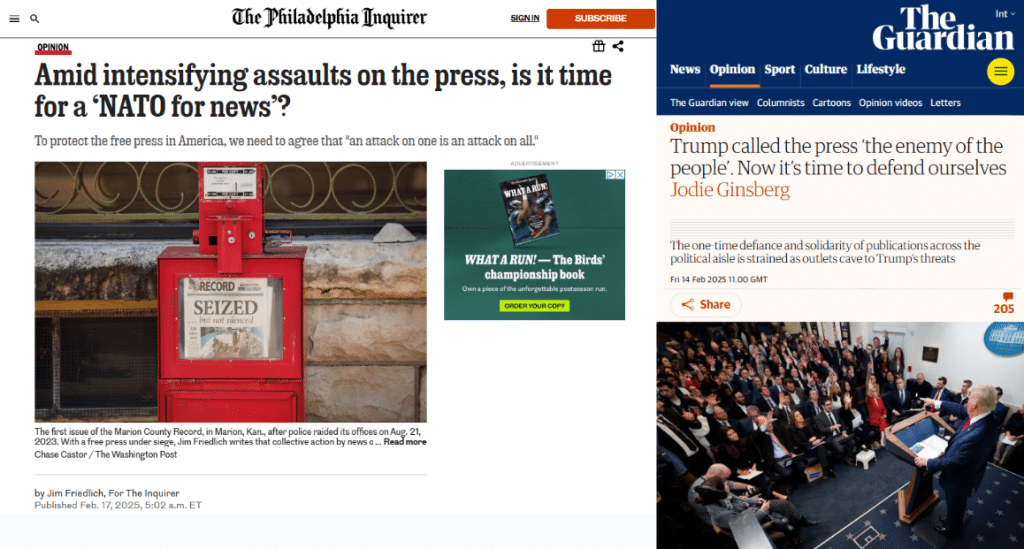
Two opinion articles from The Philadelphia Inquirer and The Guardian highlighting concerns over press freedom and political threats to journalism. The discussions reflect on increasing attacks on media institutions and the need for collective action to protect democracy.
She highlighted the Trump administration's intensifying attacks on democracy, civil liberties, and marginalized communities, noting that these actions are specific — focused on restricting and redefining what independent media is and creating favored treatment around government-aligned media.
One of the significant points raised was the potential for government-aligned media to shape public perception. Millar cited the example of Jeff Bezos' influence at the Washington Post, illustrating how powerful individuals can impact media narratives. She also pointed out the increased risks for whistleblowers and sources, creating a chilling effect on investigative journalism.
The discussion also touched on the broader impact of these issues on regular citizens. Millar mentioned concerns about immigration status, the right to protest, voting rights, personal privacy, and digital security. She stressed that the challenges faced by journalists are often mirrored in the daily lives of ordinary people.
Economic and social instability, including cuts to social programs, mass deportations, and climate deregulation, further exacerbate the situation. "This is creating economic hardship for a lot of people, and it really means that we need more accountability journalism than ever before," Millar asserted. Suppressing media freedom through blacklisting, lawsuits, and controlling narratives is a concerning trend that demands attention and proactive measures.
Millar provided specific examples of these tactics. She mentioned Trump barring the Associated Press (AP) from the Oval Office and Air Force One due to a disagreement over terminology, a move that signals a tightening grip on media access. She also discussed instances of local governments and law enforcement agencies feeling emboldened to restrict access to journalists, reflecting a trickle-down effect of national-level actions.
The situation in Canada was also addressed, with Millar noting the rhetoric from the Conservative party leader Pierre Poilievre regarding government subsidies and attacks on the Canadian Broadcasting Corporation (CBC). She warned against complacency, urging Canadian media to learn from the developments in the U.S.
A key takeaway from the webinar was the importance of preparedness. "If there's one call to action from this presentation, it's to take a step back now and think about what we can do before something happens, so that we're prepared for that," Millar emphasized. She encouraged media organizations to develop strategies to resist effectively and build alternative systems for support and resilience.
Specific tactics discussed included framing attacks on the free press as payback for "incompetent left-wing coverage," tightening controls over media access, and using legal threats to punish critics. Lawsuits against media organizations and blacklisting critical outlets were highlighted as significant concerns. Millar also mentioned the White House seizing control over media access and the Pentagon shielding cabinet officials by replacing critical outlets with "friendly" ones.
Furthermore, Millar noted the broader push to limit public access to government information, including pulling data from government websites and barring government agencies from speaking publicly. She also raised concerns about potential weakening of Freedom of Information Act (FOIA) laws.
In response to these challenges, Millar offered several suggestions. Collaboration and networking among media outlets were deemed crucial for resource sharing and mutual support. Joint fact-checking initiatives and ensuring reporters understand their rights and legal resources were also emphasized. She recommended having readily available contact information for organizations like the Committee to Protect Journalists (CPJ) and PEN America.
Building trust with communities was another vital point. Millar advocated for transparency in journalistic practices, disclosing methodologies, sharing sources, and highlighting journalists' expertise. She cited examples from the New York Times and Conecta Arizona, which have successfully engaged with their audiences and opened up their processes.
Overall, the webinar provided an overview of the challenges facing media organizations and offered practical strategies for navigating these uncertain times. By fostering collaboration, ensuring preparedness, and building trust with communities, independent media can strengthen their resilience and continue to deliver impactful journalism. The discussion served as a timely reminder of the importance of press freedom and the need to protect it in an increasingly complex world.

Indiegraf is the operating system for independent local media.