

Thank you! Your submission has been received!
Oops! Something went wrong while submitting the form.



A/B testing (also known as split testing) is an important part of product experimentation, as it helps you make informed decisions so you can optimize your publication and content. In this guide to getting started with A/B tests, you’ll learn the basics of this essential marketing experiment
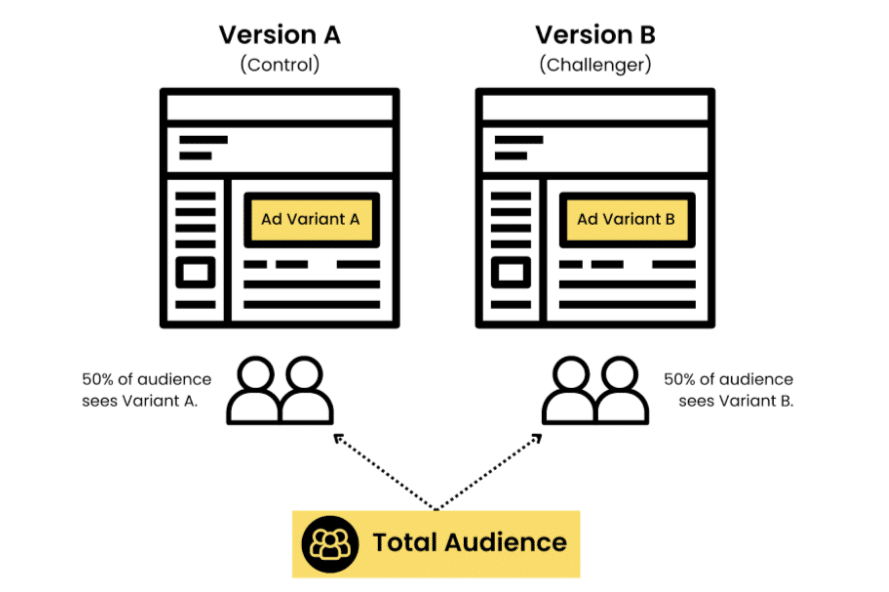
A/B tests can be used for a variety of product experiments. They’re sometimes called “split tests” because you split your traffic 50/50 to test two versions of one piece of content with changes to a single variable. By testing these two versions, you can analyze their performance so you can optimize content and increase ROI.
A/B testing is very flexible, but here are some key content types you should consider testing:
Because A/B testing is so flexible, sometimes you end up running tests when you shouldn’t. Here are some situations where A/B testing is not the best option:
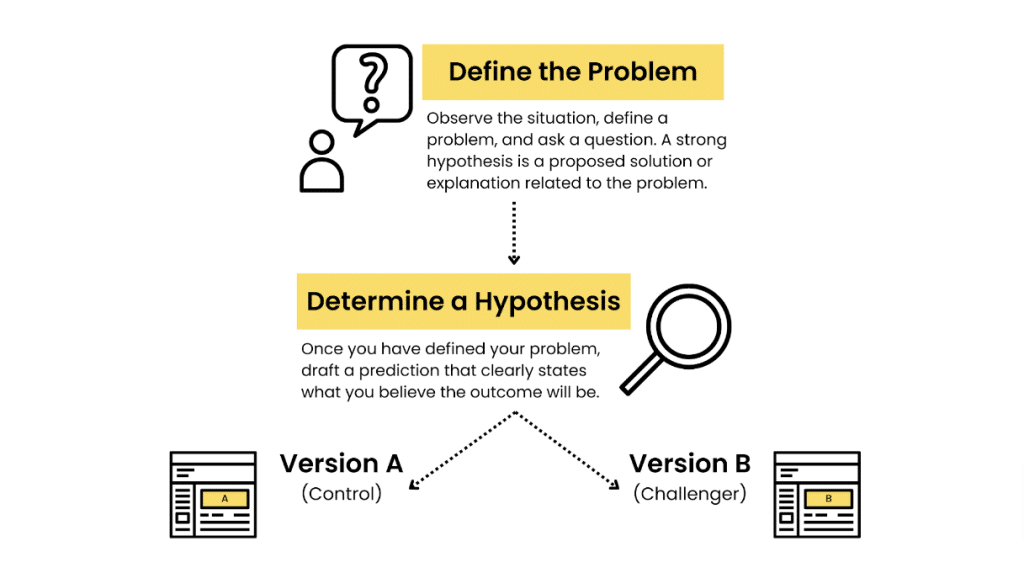
Before you set up and run your first A/B test, you will want to define a problem and then develop a hypothesis. Make sure your hypothesis is aligned with your publication’s business and editorial goals. A strong hypothesis should include three main parts: the variable, the desired result, and the rationale behind it.
For example, if you’re designing house ads you might want to test the color of the CTA button. Your hypothesis could be, “If we change the button color on our house ad, then more people will click on it because the yellow is a higher contrast than the green button”.
Now that you know what you want to test, you need to determine how long to run the test and how many readers (aka sample size) you need to reach for your results to be statistically significant. Trying to calculate your test duration and sample size can be tricky, that's a lot of math! But don't worry—there are plenty of free calculators available that you can use (like this one here).
Investopedia defines statistical significance as a determination that a relationship between two or more variables is caused by something other than chance. It is used to provide evidence concerning the plausibility of the null hypothesis, which hypothesizes that there is nothing more than random chance at work in the data.
As we mentioned earlier, our recommendation is to wait until you have an audience size of at least 1,000 readers or monthly website users before you start to conduct A/B tests. While this isn't a firm rule, if your audience is smaller than this, you may have a difficult time getting enough responses to reach statistical significance.
There is no set duration for how long an A/B test has to run, but you should expect to commit a minimum of two weeks to each test. This can vary depending on how big the variation is. The smaller and less obvious the change, the longer you may need to run the test.
Once you have finished running your A/B tests, refer back to your hypothesis. Based on the results, did you prove or disprove your hypothesis? If you were running your split test through an ESP or through A/B Testing software, check if a winner has been declared. Many platforms do a basic analysis for you. Typically, a winner will be declared if these two conditions are met:

You should also review the following metrics (if applicable):
Remember, there's no guarantee that your hypothesis will result in a winning test, no matter how well you research it.
Sometimes A/B test results will come back as inconclusive—and that’s okay! Don’t get discouraged. You can revise your hypothesis or your variant, and try again. An inconclusive answer can happen when the results of your test are too close to determine a clear winner. The next step is to make changes to your A/B test based on data from each experiment and continue to test until you find your ideal outcome.
Key takeaways
Indiegraf has all the solutions to help meet your outlet’s digital advertising needs. We offer Indie Ads Manager, an integrated platform designed to streamline ad fulfillment, and strategic advertisement and sponsorship planning from our Indiegraf Experts team. If you’re interested in taking your publication’s advertising program to the next level, let’s chat! We are happy to help.

Indiegraf is the operating system for independent local media.