

Thank you! Your submission has been received!
Oops! Something went wrong while submitting the form.



Like all areas, sponsorship and advertising sales will ebb and flow throughout the year. Tracking your gross ad sales revenue is a critical part of annual planning. Month-over-month and (eventually) year-over-year mapping will help you understand trends in your market, letting you know when and where your efforts are best served.
Keep reading for Indiegraf Experts tips on how to get started with an ad sales routine.
Consistency is crucial. Set aside a specific amount of time each day to focus solely on ad sales. Even an hour daily can make a significant difference in building momentum. Scheduling time ensures you stay on top of your ads and sales workflow and meet your targets.
Maintain a record of all your meetings and interactions with advertisers. This helps you keep track of conversations, follow-up tasks, and potential opportunities. Use a CRM or a simple spreadsheet to log your activities. Tracking your efforts is especially important when managing ads and sales across multiple platforms.
Understanding your sales close rate can make your ad sales process more predictable. If you know how many leads typically convert to sales, you can estimate how many prospects you need to contact to meet your goals. Direct
advertising becomes easier to scale when you have clear metrics to guide your efforts.
Persistence is key in ad sales. Keep following up with potential advertisers until they explicitly ask you to stop. Many deals close simply because one party consistently stays top-of-mind. If you're wondering how to put ads on your site and make the process seamless, consistent follow-ups can help secure the right advertisers.
Creating a structured plan for your ad sales activities can be very helpful. Set specific revenue goals (e.g. monthly, quarterly, annually) and draft speaking notes. Clearly articulate what makes your advertising service unique with a value proposition.
It is also important to plan for promotions, discounts, or bundled services to attract clients. Having this information prepared in advance will help you speak with confidence about your product.
Pro Tip: Use a lead list spreadsheet to monitor potential advertisers and their status. Keeping this list up to date helps streamline your efforts for direct advertising opportunities. Add notes about a potential advertiser’s goals and values to help guide your communication.
Smaller publications can compete effectively with larger ones by leveraging unique strengths and adopting targeted strategies:
READ MORE: How to make effective ads that readers actually respond to
Improving retention rates in a predominantly digital environment can be more challenging than in traditional print advertising. Still, enhancing your renewal and retention rates is incredibly worthwhile. Retaining an existing sponsor requires significantly less effort than acquiring a new one, making it a worthwhile focus for your digital advertising strategy.
Instead of selling one-time sponsorships, aim to bring sponsors on with longer-term contracts. For newsletter ads this could mean selling one ad per month for a quarter. For display ads, you can sell 3-month and 6-month packages. With larger sponsorship opportunities, sometimes year-long or even multi-year contracts are appropriate.

You can also create advertising bundles by combining email, display, and social media or content advertising into discounted packages. Bundles can simplify the process of managing ads and sales for both you and your advertisers.
Here are more ways to increase your retention rate:
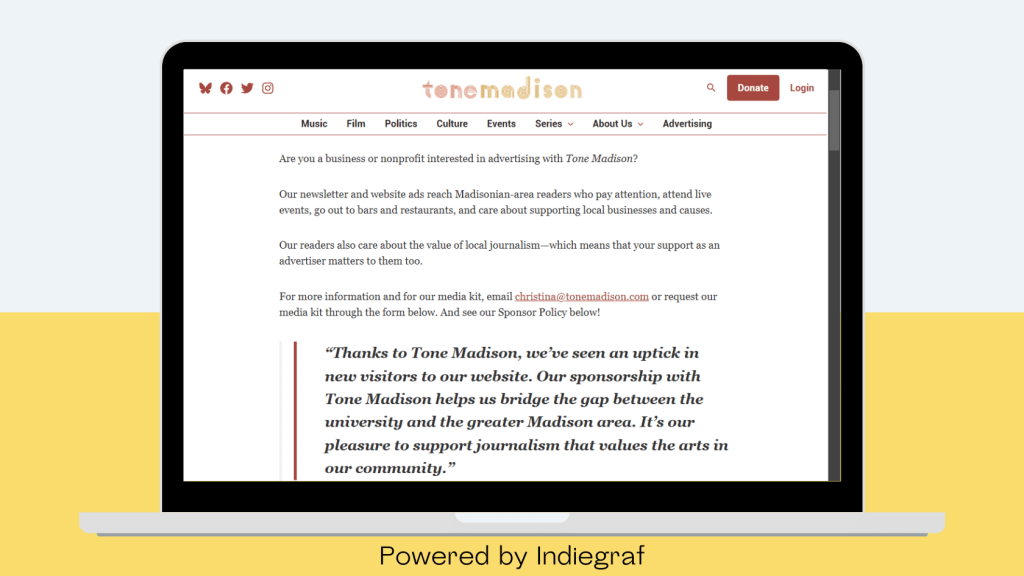
Review from the University of Wisconsin–Madison Division of the Arts (Tone Madison Sponsor)
One of the best ways to increase your renewal and retention rates is to show your advertisers the return they’re getting. Impact reports should be sent to sponsors:
A simple report sent to advertisers that includes a thank you, some metrics, contact information, and an offer to rebook should be sent out regularly. For a one-time advertiser, this should be done within three business days of the ad running. For longer-term advertisers, sending a report out once a month is a good option.
To ensure advertisers see value in their investment, measure the success of their campaigns effectively:
When an ad campaign underperforms, turn it into an opportunity to strengthen your relationship with the advertiser:
For example, you have a regular advertiser whose newsletter ads underperformed due to heavy text and unclear messaging. You can offer to design and run a free campaign using best practices. The results were significantly better, and the advertiser became more informed and satisfied with future campaigns. This approach can transform ads and sales into a collaborative effort that benefits both parties.
In conclusion, if you’re on the journey to learn strategies on how to sell ads or how to increase ad sales for your publishing business, it’s important to start with the basics. By creating a regular sales routine and tracking your progress, you can build relationships with advertisers. This will help you see better results in your ad sales.
📌 A strong ad sales routine is just one piece of the puzzle—see how it connects with pricing, formats, and more in our website and newsletter ads guide.

Indiegraf is the operating system for independent local media.