

Thank you! Your submission has been received!
Oops! Something went wrong while submitting the form.



Whether you are looking to convert your current readers to paid subscribers or reach new readers, an effective ads strategy should form the foundation of your business planning. This includes creating campaigns that are relevant to your target audience and implementing those campaigns in a way that positively impacts your reader's overall experience.
Before planning your advertising strategy, it’s crucial to get to know your audience. A good practice is to create detailed profiles of your target user segments. With these profiles, you can begin crafting your ad design, powerful messaging and placement specifically to target these segments.

To keep track of this work, consider developing a style guide for your advertising content, similar to an editorial style guide. This guide should outline the criteria for your publication’s ads and evolve as you learn what works best for your target audience.
You can utilize tools like Pew Research Centre, Statista, or Nielsen to conduct research into your targeted audience to inform your targeted ad design strategy. Each organization conducts and publicly shares research that will help you understand the current trends, messaging, and content your audience profiles are resonating with.
Collecting first-party data directly from your readers through audience surveys is also a great way to learn more about your audience and align your marketing efforts with their needs.
Effective ads not only capture attention but also compel readers to take action. By taking into consideration your readers' preferences and demographics, you can craft thoughtful, engaging messages that resonate with your audience, ultimately driving both engagement and revenue growth.
A strong call-to-action (CTA) is the foundation of an effective ad strategy. Like a compelling headline, a well-written ad encourages readers to engage and click through to learn more. Here are some tips for crafting effective CTAs:
When designing ads for website or email newsletters across tablet, desktop, and mobile, consider these ad best practices:
In particular, publishers should be aware of how much of their traffic is coming from mobile devices. Many of us do our work on desktops and so we unintentionally design for desktop-first. However, most publishers receive the majority of their traffic from mobile users. It's more important to optimize for a mobile experience than a desktop one.
Deploying ads that make it difficult for users to access the content they’re visiting your site for will alienate your readership and can lead to diminished engagement.
A fundamental approach to avoiding this is to ensure you are selecting the correct size for your ad placements. The specific size will depend on the site or platform, but you should keep these best practices in mind:
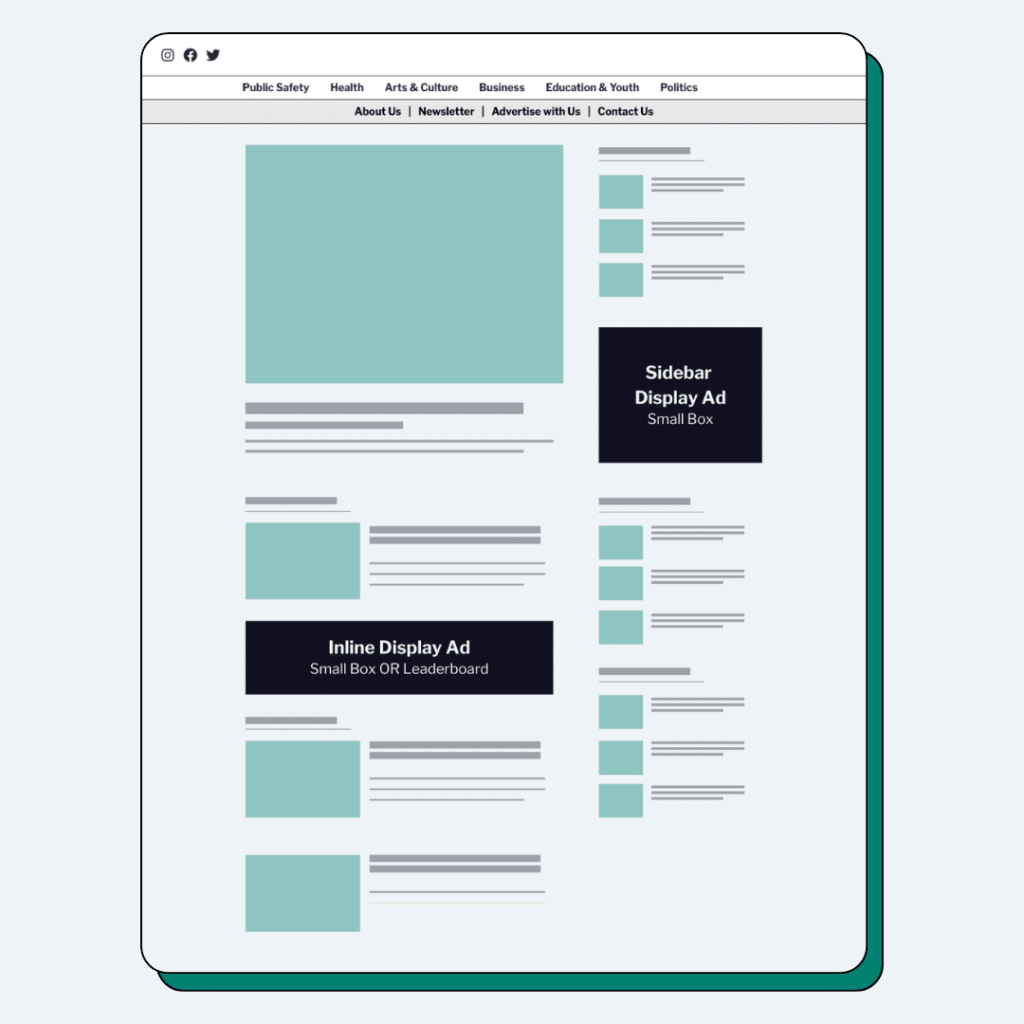
Display Ads placement on a news website
When choosing advertising formats, you should consider when to use popular formats, as well as the pros and cons of each.
Banner ad design involves rectangular or square ads displayed at the top, bottom, or sides of a page.
Windows or overlays that interrupt the reader.
Also known as sponsored content. Ads that blend in or appear alongside content offerings.
Full or interspersed video segments.
Ads that break up content and take up a portion of the whole page.
Read more: “Navigating sponsored content. A guide for newsrooms and publishers”
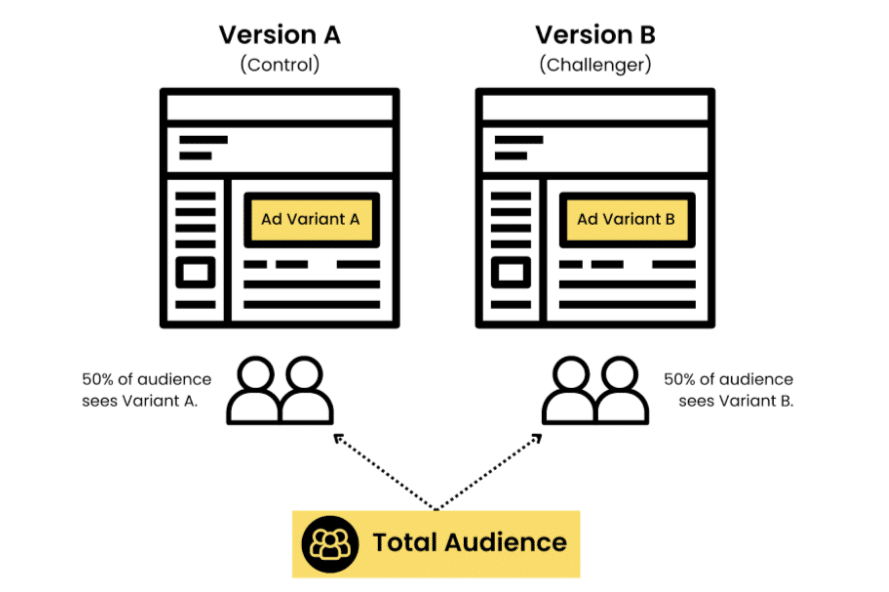
Creative ad design best practices will always include regular A/B testing. In the simplest terms, A/B testing will compare one iteration or option for an advertising campaign against another over a period of time to compare which performed better.
For example, you can compare two versions of your CTA to see which is driving more engagement. Or, if you are introducing a new ad placement or format, you may want to compare user response to that change.
It’s important to build an effective ads strategy that acknowledges the core values of your publication and readership and responds to them much the same as your editorial content does. To do this, it's key to tap into the core value proposition of your publication and ensure that it’s informing the type of ads you’re displaying.
For example, suppose your publication is focused on investigative journalism. In that case, it’s safe to assume visitors to your site have the intention of understanding or following along with strong, mission-driven journalism. Your advertising campaigns should also align with this tone.
📌 Strong ad copy boosts results, but it’s just one piece of the puzzle—see the full picture in our website and newsletter ads guide.
Indie Ads Manager is your ultimate digital advertising tool. Leverage a streamlined, integrated platform to deliver ads across your website and newsletter. Book a free call with us today to learn how your publication can start growing ad revenue.

Indiegraf is the operating system for independent local media.