

Thank you! Your submission has been received!
Oops! Something went wrong while submitting the form.



Understanding the distinction between misinformation and disinformation is crucial for newsrooms and local publishers in their fight against false information. Let's explore these concepts and their impact on local journalism.
Misinformation refers to false or inaccurate information shared without the intent to deceive. It often spreads when people unknowingly pass on incorrect facts, believing them to be true. Local newsrooms play a vital role in combating misinformation.
Disinformation is false information deliberately created and spread to mislead or manipulate people. It's a more malicious form of false information, often used for political, economic, or social gain. Local news publishers are essential in exposing and countering disinformation campaigns.

The Discourse reporter Julie Chadwick’s deep dive into a human rights complaint against the City of Nanaimo helped reframe the public’s understanding of a controversial figure in local politics. Photo by Jesse Winter/The Discourse.
Most local journalists don’t have the time to read a 100-page report for a story. They talk to people who have, skim the text and find other tactics to ensure they can file three to five stories a day. Most members of the public don’t either.
But reporting civic issues in-depth, building from weeks of research and interviews, plays a critical role in tackling misinformation for reporters and editors at The Discourse, an independent, audience-funded news outlet serving the communities of Cowichan Valley, Nanaimo and Comox on Vancouver Island.
Recently, lead reporter Julie Chadwick combed through a human rights tribunal case launched by the City of Nanaimo’s former chief financial officer Victor Mema, one of the city’s few Black staff members.
He was fired in 2018 after he racked up thousands of dollars of personal purchases on a city-owned credit card. While local news reports at the time had framed Mema squarely as a criminal, the BC Human Rights Tribunal concluded in August of this year that Mema’s termination was discriminatory on the basis of his ancestry, place of origin, race and colour.
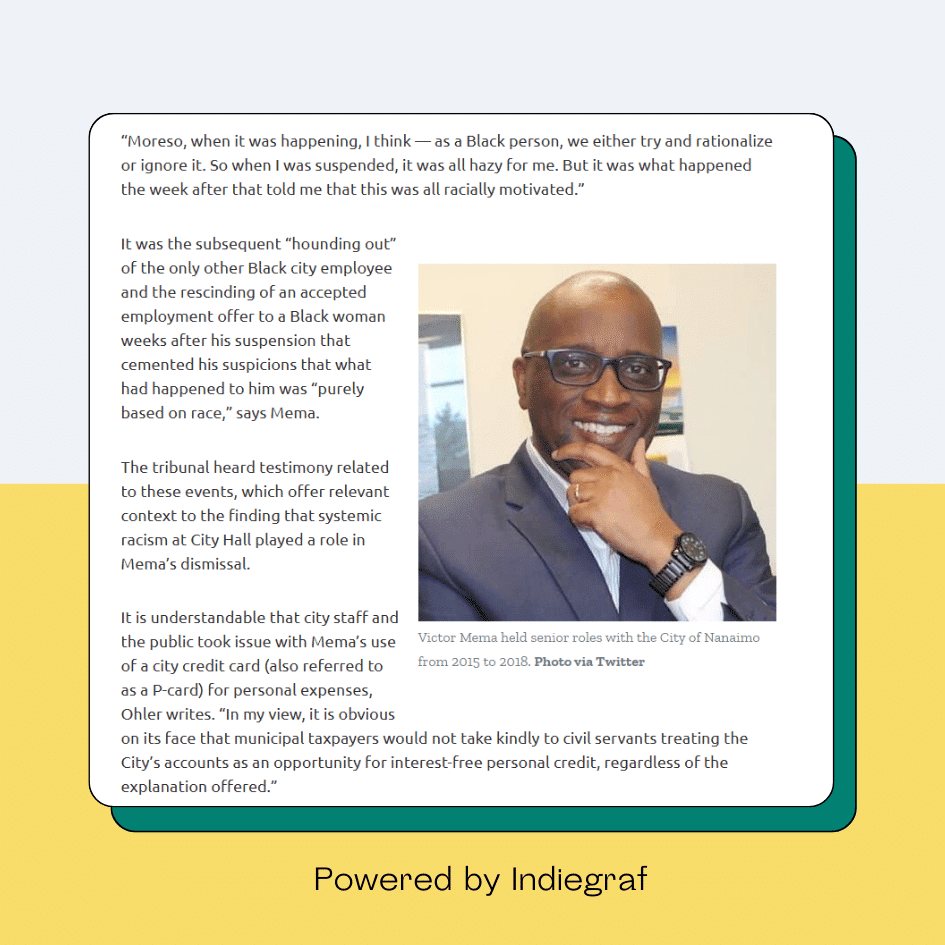
Other local news outlets covered the human rights tribunal ruling in less than 1,000 words. But Chadwick’s story for The Discourse was more than four times that length, drawing from the tribunal’s findings, the political context and a long-form interview with Mema himself.
“The details that were brought out through the tribunal process added so much complexity and nuance to what was previously publicly known about the story from earlier news reports,” says Jacqueline Ronson, managing editor of The Discourse.
Julie Chadwick actually took the time to read the report, and recognized how much those details of what happened at the time and through the tribunal process were really important for the public's understanding of what happened and why the tribunal made the decision it did.
“Certainly not everybody would spend the time to read the whole thing,” Ronson adds. “But even those who could read the first 500 words would understand something about the story that they didn't before if they were just relying on previous media reports. And those who were interested could spend more time to learn the details.”
Journalists writing for online outlets are often encouraged to write short and cater to dwindling attention spans. But when we consider local news as a public service delivering civic information needs, it becomes clear that there’s an important place for in-depth, long-form journalism.
While research from Chartbeat has found that nearly half of readers leave an article 15 seconds after they load it, Chartbeat has also found that among people who do read longer-form articles, engagement increases up to about 2,000 words.
Long-form and investigative journalism takes longer and costs more to produce—Chadwick’s deep dive into the human rights tribunal cost more than $2,000. It’s understandable why many news outlets are opting for quick-turnaround articles.
But The Discourse’s entire business model is built around this investment.
We know that in-depth, rigorously fact-checked journalism engages our readership, which translates to funding. Research from Hearken confirms that when journalism directly answers reader questions, readers are in turn more likely to pay for the reporting.
“The people who support us tell us that they care that we go deeper than the other local media and that we help people understand what's happening in a more nuanced way,” says Ronson. “People are really hungry for that additional depth.”

With opposition to 2SLGBTQ+ inclusion policies in schools on the rise, local reporters play an important role in separating fact from fiction. Photo by Jacqueline Ronson/The Discourse.
For Cowichan Valley editorial lead Shalu Mehta, in-depth journalism on civic issues is also critical to bridging divides.
Her explainer on school policies and curricula related to sexualities and gender identities answered a series of basic questions about how this shows up in local schools.
Rather than reporting on the conflict—largely between parents who mistakenly believe the gender and sexuality policies are “grooming” children and parents who believe in human rights and education on inclusivity—she went back to basics.
“What I noticed was missing was just facts—facts about what [sexual orientation and gender identity curriculum] was, and what it looks like in schools with examples of what it looks like and a space where I could provide links that are fully just answering people's questions.”
Similarly, her recent in-depth explainer answered eight community questions from a town hall about a controversial estuary project for a combined 4,000 words.
“After watching the town hall, I realized that there were a lot of people who didn't really fall on either side of this issue, but instead, were just there because they had legitimate questions that they couldn't find answers to online,” says Mehta.
She spoke with people afterwards and recalls that when they first heard about the proposed project, they were against it because of the loss of farmland, Mehta recounts. “But they read my story, they ended up getting answers…and then they were able to make a more informed decision on where they stand.”
“[We’re] really just doing a service to the community by making all those facts live in one place and doing that work of fact-checking and aggregating it,” says Mehta. “It's something that a lot of people don't have time to do.”
While many outlets deliver this kind of civic information during elections, Mehta believes there’s value in applying this approach to other issues.
Read more: “3 tips for building trust with readers through election coverage” How do you provide election coverage in a community concerned about voter fraud?
“When I have community members coming to me directly with questions and saying, we need to understand more about this—that gives me direction. And so I'm really grateful for an engaged community that helps us do this work.”
Ronson agrees that refocusing local news on the goal of informing and empowering people to take action has inherent value. “That understanding helps people take action in their lives to make their communities better places. It helps them better understand their neighbours and people that they might disagree with. And it helps them connect with each other and work together towards facing some of the issues that they want to see tackled.”

Indiegraf is the operating system for independent local media.