

How is advertising a source of revenue?
Ad revenue is the lifeblood of news organizations big and small. From the tiniest indie outfit to the New York Times, advertising is a solid way to monetize a website, a newsletter or even a podcast, and give publishers more time to focus on why the publication began in the first place — journalism.

To Mark Talkington, founder and publisher of the Palm Springs Post, most indie publishers are journalists first and foremost. He was first exposed to the ad business as a high school student while working for a weekly newspaper run by his future mother-in-law, but managing ads wasn’t in his job description. At MSN, where Talkington spent over 20 years, an entire team was devoted to ads.
Still, when he decided to start the Palm Springs Post, an independent community news site covering the California city, in 2021, he understood just how tricky the ad business could be. “I knew how tough it was to sell ads,” he recalls. “I knew how tough it was to get people to pay for ads and I really wanted nothing to do with it.”
Today, around half of the Palm Spring’s Post revenue comes from advertising. As Talkington found, there are ways to teach indie publishers with even a minimal understanding of the ad business how to monetize a website. It all comes down to understanding your publication’s value to its readership — and the sorts of advertisers who might want to reach them, too.
Understanding your audience: The foundation of ad revenue
To develop a stable ad revenue strategy, you need to figure out why advertisers would see your publication as a good way to reach their target audience. And you can’t do that until you know who your readers are. “One of the best ways to understand your audience is just to start collecting data early on,” says Allison McIlmoyl, senior product manager for advertising at Indiegraf.
That means connecting your website to services like Google Analytics, as well as distributing demographic surveys, to figure out your audience’s quirks and habits. How often do people visit your website? What percentage of them click on your publication’s email newsletters? How long do they spend reading particular stories? What’s their education level or household income?
The resulting data, McIlmoyl says, can help you build out a customer persona, or a model of the average reader using your website. By doing so, she adds, you can better understand the sorts of companies who’d make a good advertising partner. At the very least, you can learn which advertisers to avoid.
Talkington admits he didn’t do a lot of audience research when first drafting up his publication’s ad revenue plan. But he did draw clear lines on who he wouldn’t work with. Air conditioning and automotive companies were out, he says, because they don’t have a great reputation among consumers. So were all political candidates, regardless of their affiliation, as well as companies selling intoxicants like cannabis. “I think it just cheapens the brand,” Talkington says of the latter, “and I just don’t want to go there.”
If you want to know more about your readers but are unsure of where to start, get in touch! Our audience team has all the know-how to help make the most of audience research. Book a chat with our team!

Matching your audience to advertisers: A recipe for ad revenue success
Once you’ve determined who your audience is, and what they’re into, you need to figure out how that audience might be useful to an advertiser. Generating ad revenue may be as simple as approaching organizations whose clients are similar to your readers. Publication size doesn’t necessarily matter. In today’s advertising world, niche is king, and indie publications are well-placed to deliver eyeballs to paying advertisers who fit with their mission.
“We have a lot of publications that focus on LGBTQ rights or race,” McIlmoyl says. “Those audiences can be harder to reach, especially for the smaller businesses that need to reach them. Any big company can drop a bunch of cash into programmatic ads and target an audience, but not every company can develop a relationship where they’re able to speak directly to their potential customers.”
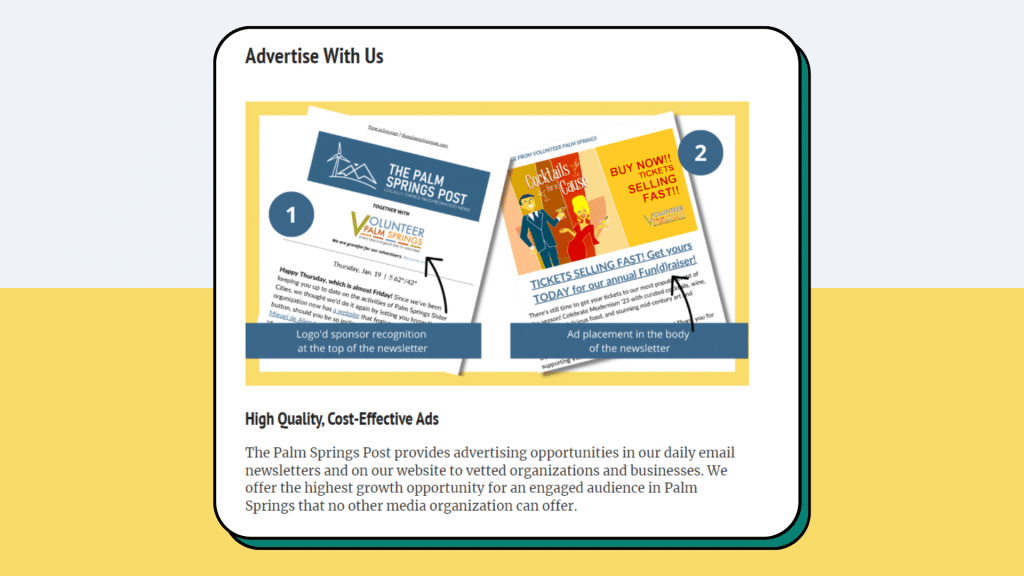
At the Palm Springs Post, Talkington says the vast majority of advertisers are service organizations like DAP Health, a nonprofit health provider in the Coachella Valley, as well as the city of Palm Springs itself. The publication’s reach in Palm Springs makes it invaluable to advertisers “[Advertisers are] now realizing that the best way to reach the majority of people who live in our city, full-time, is through the Post,” he says. “We have 16,000 subscribers, which is more than half of the actual physical homes in the city.”
Unlock additional tips 📖 Mastering paid sponsorships: Increase your paid sponsorships revenue with more effective communication. Follow this advice from two of our Indiegraf experts.
How much should I charge for an advertisement? Start low, aim high
When setting ad rates for the very first time, don’t be afraid to go low. In fact, McIlmoyl says, don’t be afraid to give away freebies to friends or contacts with businesses. Your first customers will get some free exposure out of it, and you’ll start building your credibility as a venue for other organizations to buy ads.
“We’ve done that with a lot of publishers to get started,” McIlmoyl says, “and then they slowly start charging a little bit and then ramp their prices up. It’s been a pretty successful way of bringing advertising business in.”
The key is to keep steadily raising your ad prices as your publication’s audience grows. At first, the Palm Springs Post got a contract with someone for $250 a week for prime placement inside their newsletter. Over the course of a year, Talkington says, the Post sold out of ad slots, thanks in part to the Post’s conversion rate: some ads can be in the double-digit range.
So the Post’s rates didn’t stay at $250 forever. “We went from there to $350, from there to $400,” Talkington says. “Now, I think we’re at $500 as our circulation grows and our reputation grows.” To be clear, not every advertiser at the Post pays this rate. Some advertisers are on longer-term contracts that pay less, while others are part of five and even six-figure deals for sponsored content and other ads.
“They get a lot of value for what we do,” Talkington says of these larger deals, “but they work. They work, and it’s really nice.”
💡Pro tip: Access Allison McIlmoyl’s recorded webinar, where she and Sam Hoisington share exclusive insider tips on mastering ad sales and boosting your revenue potential.
How Indiegraf drives ad revenue
Using Indiegraf’s products and services, publishers can do everything from understanding their audience to growing their revenue. Indie Ads Manager specifically lets publishers serve ads to their website or email newsletter, monitor their publication’s audience and even give metrics to advertisers in real time. The Indiegraf Experts team also provides invaluable support to publishers who are already wearing many hats at once.

The Palm Springs Post’s editorial team is just two people: publisher Mark Talkington, and editor/reporter Kendall Balchan. Talkington credits Indiegraf with handling the day-to-day business of drumming up ad revenue and handling audience development campaigns, leaving him and Balchan to cover Palm Springs.
“I sign off, but I don’t have to do all the dirty work,” Talkington says. “That allows me as a two-person newsroom, to function like a ten-person team.”
At Indiegraf, we understand that navigating the world of news entrepreneurship can feel overwhelming. The journey from crafting compelling stories to generating sustainable ad revenue is complex, but you’re not alone. We’re here to be more than just a tech provider – we’re your companion in this journey.
Let us handle the intricacies of audience insights and ad strategies, so you can pour your passion into creating impactful publishing!


