

Newsletters are one of the most effective ways to lure readers into your publication’s funnel. They are important for creating what researchers at Northeastern University call a habit of readership. This habit attracts first-time visitors and keeps them as loyal digital patrons. The newsletter introduction is where the process of converting a first-time reader to a supporter begins. Like the lead in a news story, a newsletter’s opening message is key to attracting readers. It helps pull them into the story being told.
This could be a simple summary of a big story on your site’s homepage. It might also ask readers for help. It can call for sources or stories. It could even serve as its own editorial platform.
Regardless of your publication’s ideas for a newsletter, you must nail the introduction. Readers’ inboxes are crowded at the best of times. Newsletters that stand out from the pack bring a signature tone to the first few lines of their editions, even if they’re simply delivering a straight recap of the day’s news. It can be formal and authoritative, or laid-back and casual, but your newsletter must have a voice.
Read more 👉 Email newsletter 101: A complete guide for independent publishers and journalists
Here are some ways to grab your email newsletter readers’ attention. The goal is to turn them into lifelong supporters of your publication.
How to write a newsletter introduction
Newsletter introductions are not a one-size-fits-all affair, just as no two publications will share the same tone. But there are a few ground rules all successful newsletters consider when publishing.
Here are some of our favorite Indiegraf Experts tips and examples from our network of publishers.
Tip 1: Keep your intro short and impactful
Brevity and focus are key. You are competing for your reader’s attention in a distracting world. Don’t wait until three paragraphs in to get to the point. Not unlike a good news story’s lede, a newsletter intro gives a reader a sense of what’s important, fast.
It doesn’t need to be a Pulitzer-winning story. However, the introduction should connect to the content of that newsletter edition.
Tip 2: Keep it authentic
Good newsletter introductions are also instantly recognizable in tone or structure. They have a life to them, even in publications with impartial or neutral tones. Brevity, wit, and even humour can work well. So can a unique stylistic touch.
In Eden Fineday’s IndigiNews newsletter, every edition opens with a greeting in Cree. This not only sparks a reader’s interest but also shows what IndigiNews is about. It focuses on decolonizing settler colonial media by highlighting Cree and other Indigenous stories.

Tip 3: Keep it consistent
All newsletter openings must be consistent in structure. If your newsletter always opens with a letter from the editor, for instance, randomly publishing a newsletter with an infographic is going to confuse readers. And if readers can’t figure out what you’re trying to do with your newsletter, they’ll simply unsubscribe.

February 19, 2024
Tip 4: A/B test your newsletter intro
To optimize your newsletter introductions, it’s key to understand what your audience likes and wants. A great way to do this is by implementing A/B testing strategies. If your email service provider allows for A/B testing—like Indie Email by Indiegraf, which offers robust A/B testing features—you can test different approaches to see what resonates best with your readers.
Split your audience into two groups and send each a different version of your introduction. Experiment with variables like tone (formal vs. casual), length (short vs. long), or content focus (story-based vs. fact-based). Then, analyze metrics such as open rates, click-through rates, and engagement time to determine which version performs better.
Use these insights to continuously refine your approach, ensuring your newsletter becomes more engaging and effective over time.

How to introduce yourself in a newsletter
Once you know the basics of an email newsletter introduction, you can think about how to use it in your publication. Newsletter introductions can take all sorts of forms. For a globe-spanning publication like The New York Times, they summarize the day’s biggest stories in just a few lines to millions of daily readers.
At an indie publication like yours, a newsletter has all sorts of uses. It can build trust with your audience, highlight your biggest stories, and even appeal for subscriptions. Here are some introduction styles we love, along with examples from our network.
Personal connection: Build trust with readers
Newsletters, as an intimate medium, are a great way for publications to blend the personal and the professional. For The Pulp, co-publisher Erika Frederickson starts an edition on National Poetry Month by reminiscing on some of her favorite poets over the years, including one she attended grad school with. This poetry opening leads us to the idea of poetic justice. It then connects to a docu-series about Montana, which is the main focus of The Pulp’s coverage.

Cold open: Get straight to the point
A cold open skips the small talk and dives straight into the relevant information of the newsletter. NowKalamazoo opens with the local weather and a summary of the most important news in Kalamazoo Country, all in just a no-nonsense line and a half. The Palm Springs Post follows a similar format in its introduction.

Behind the scenes: Share the story behind the story
This writing style pulls back the curtain, giving readers a glimpse into the work behind the newsletter. For example, IndigiNews publisher Eden Fineday opens one recent edition by recounting a virtual appearance at a Carleton University journalism class and a presentation for staff at the Toronto Star, and why decolonizing the media is so critical to her publication’s mission. A “behind the scenes” opener is more than just a slice of life. It allows a publication to share its editorial values with the audience.
Why it matters: Highlight the bigger picture
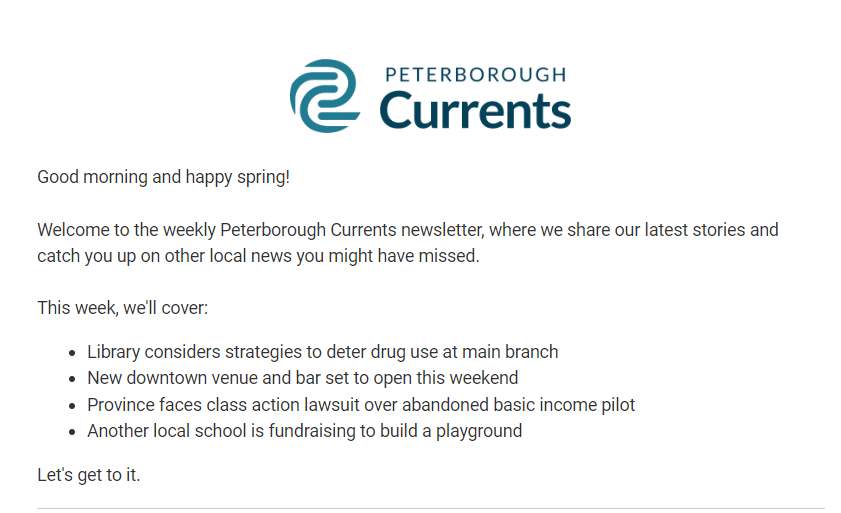
Writing why it matters to you is key to connecting with readers. Some newsletters will use the introduction of a newsletter to unpack why a forthcoming story is worth reading, rather than giving the story away in the opening paragraph. In a Peterborough Currents edition, publisher-editor Will Pearson opens with his thoughts on what an upcoming story about a park development says about public space as a limited resource.

This style works well because it connects with readers. It shows how the story relates to their lives and bigger social issues. This creates a deeper and more meaningful bond with the audience.
The takeaway
Great newsletter introductions are built on two pillars: solid writing, and an intimate understanding of the reader. Both of these are skills indie publications need for every aspect of their work, from devising an editorial plan to interpreting audience analytics.
Mastering newsletter introductions can take an indie publication’s newsletter game to the next level — and maybe even draw a new generation of devoted subscribers.


