

Financial sustainability — and even profitability — can be daunting for publishers. It all boils down to one question: “Do readers think my work is worth paying for?” If a product’s mission overlaps with the audience’s needs, the answer is yes! Once you’ve validated your idea, you can test out different monetization strategies. In this article, we’ll outline three ways to monetize a newsletter, as well as other creative revenue-generating tactics.
How much money could a newsletter make?
A newsletter’s potential revenue depends on three main factors:
- Market size: This is the total number of people that may read — and pay for — the newsletter. To calculate your total addressable market, you need a clear idea of your ideal reader, and access to census data and market research. For example, the total number of paying supporters or subscribers a local newsletter can have is capped at the population of the region it covers.
- Your readers’ average disposable income: This will inform your pricing strategy, should you decide to ask for reader contributions or set a paywall. For example, a local newsletter may want to keep costs low for readers to promote access to information, and offer higher donation or subscription tiers for those who can afford it.
- Potential advertisers and their advertising budget: In cases where the target audience does not have a lot of disposable income, consider if you can make up for that percentage of revenue with advertising.
How do I make my email newsletter profitable?
There are three main pathways to monetization for newsletters:
- Reader support
- Paywalls
- Advertising and sponsorships.
Don’t put all your eggs in one basket. You should determine the mix of monetization strategies that aligns with the product and audience. From there, pick a revenue stream to prioritize. Every option requires time and attention to be successful!
For example, publishers that cover a niche industry and offer information that helps readers get a leg up on their jobs could benefit from a paywall, supported by sponsorships. But local news publishers who want their journalism to stay free for everyone would focus on reader support, sponsorships, and advertising.
How to monetize a newsletter through reader support
Reader support refers to money that readers voluntarily give to a publication — not to access the newsletter. Newsletters that make money primarily through this method are successful because their readers believe in their mission, find their journalism valuable and want to sustain their work. Some of these news publishers are registered as nonprofits or have charitable partners, which allow them to provide tax receipts.
Here are three best practices for growing reader support:
1. When running a fundraising campaign, transparency is key
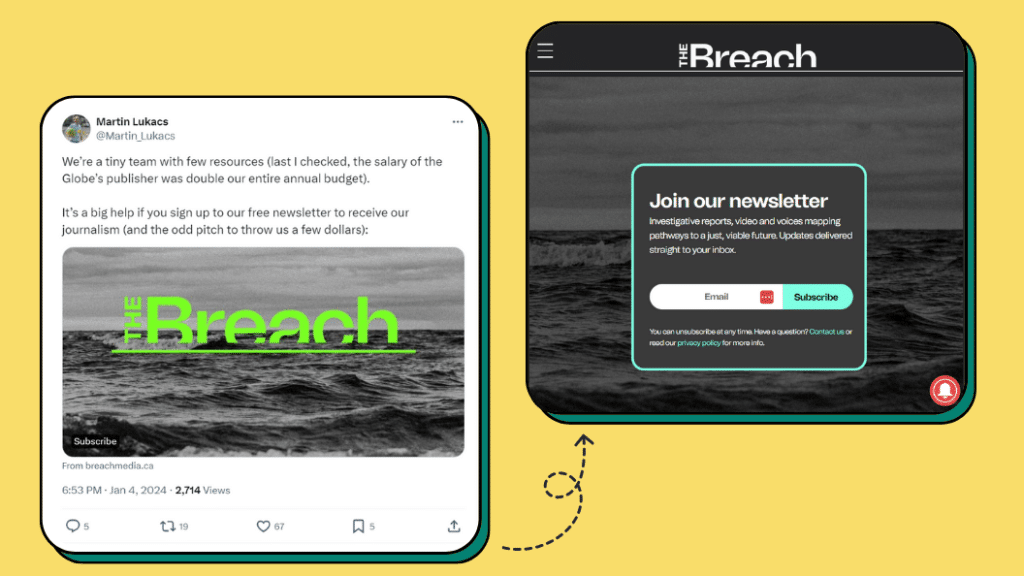
Be clear about why you’re asking for money and where it will go. By giving readers a glimpse into your finances, it can reinforce the idea that you’re here to serve them — not to chase profits. It can also show that you’re smart about how you spend money.
The Breach managing editor Martin Lukacs ended off a Twitter thread highlighting their investigations with this note:
2. Brag about your impact
Bring readers behind-the-scenes, like how The Discourse founding reporter Jacqueline Ronson wrote about how she started investigating complaints about the Vancouver Island Motorsport Circuit. A follow-up story that gives readers an in-depth look at the time and resources that go into a piece is a strong way to demonstrate the value of your work. For readers, understanding the impact of the newsletter — whether that’s representation of marginalized voices, or real-life policy changes — can be a compelling reason to give financial support.
3. Keep repeating your value proposition
What makes your publication different? Why do readers prefer your newsletter over others? Try to use direct quotes from readers for powerful testimonials, like in this appeal from RANGE Media. You can also leverage these Indiegraf tips and tricks to level up your fundraising appeals.
It will take time to grow the proportion of readers who make financial contributions. Based on data from the Indiegraf network, 3 percent is a good conversion rate from newsletter subscribers to paying supporters.
If the first fundraising campaign doesn’t yield the results you hoped for, don’t be discouraged! Consider building a supporter program and offering perks for readers who give. Keep reminding readers that their support helps you produce more of the content they like. Over time, readers will get used to the idea of supporting you financially. If they don’t, it may be time to consider a different monetization strategy.
How to monetize a newsletter through subscriptions
Subscriptions are another kind of reader revenue where some or all of the content lives behind a paywall. Publications and newsletters that make money primarily through subscriptions have a strong editorial product and a readership with the financial means to pay for access to it.

A newsletter with a hard paywall (where readers can’t access anything unless they pay for it) is rare. More commonly, newsletters will have a free edition or offer previews to paywalled content to try to get subscribers to convert. Email service providers like Indiegraf and Substack offer easy ways to send subscriber-only newsletters.
Using a subscription model to monetize your newsletter can be tricky to get right. Large publishers like The Atlantic and The New York Times offer paid newsletters, which appear to add value — but not be the driving factor of subscriptions.
On the other hand, readers may be more willing to pay for newsletters positioned as experts in their niche. For example, The Logic is a Canadian business publication with a free weekday newsletter but a paywalled website. Their core product — reporting on the innovation economy that prioritizes quality over volume — feels valuable enough to motivate readers to get a $300 annual subscription.
The key is to give away enough valuable content for free, but put your best work behind a paywall. Simon Owens, a journalist who covers the media industry, talked about how he narrowed down what his readers like about his newsletter. Without taking away anything from his free product, he added new paywalled video interviews with successful media entrepreneurs that directly addressed his readers’ questions about running a media business. Similarly, The Logic’s newsletter provides subscribers with key takeaways but to read more, they need to pay up.

How to monetize a newsletter through advertising and sponsorships
Advertising and sponsorships sell a newsletter’s readers as a product to advertisers. Newsletters that successfully leverage this monetization strategy usually have a large audience, an engaged readership (i.e. high open and click rates), a niche readership (e.g. newsletters focused on a specific industry) or a combination of the three.
At the end of the day, newsletter ad spots allow advertisers to target a specific audience and communicate with them directly. This means bypassing ad blockers and achieving higher engagement compared to traditional display ads.
This monetization strategy is all about relationship-building. Prioritize connecting with businesses and organizations that are already subscribed to your newsletter. Chances are, they’re already familiar with your publication and why it’s valuable.
The Indiegraf Experts team recommends looking for problems you can solve for an advertiser, such as visibility for a small, local business. This also gives you an opportunity to tap into a revenue stream that grows over time, as the small business grows and continues to advertise with you.
In your conversations with potential advertisers, you can offer different kinds of ad spots. At a minimum, each issue of a newsletter should have a presenting sponsor.
Additional placements include:
- Premium text links: a single line of text and a link, priced affordably.
- Featured events and listings: a small placement similar to a classified, priced affordably.
- Supporting sponsor placements: a single ad or an ad pool (where multiple ads cycle through this placement) lower in the newsletter, sized according to IAB standards, priced mid-range.
- Presenting sponsor placements: header recognition and a full ad spot (non-standard size) in native style for higher engagement, priced mid-range.
- Content: underwriting or traditional sponsored content, priced high.
- Dedicated email: stand-alone email with only sponsor content, like a promotion for an upcoming event. This should be used rarely and is the highest-value option for an advertiser, so it should be priced high.
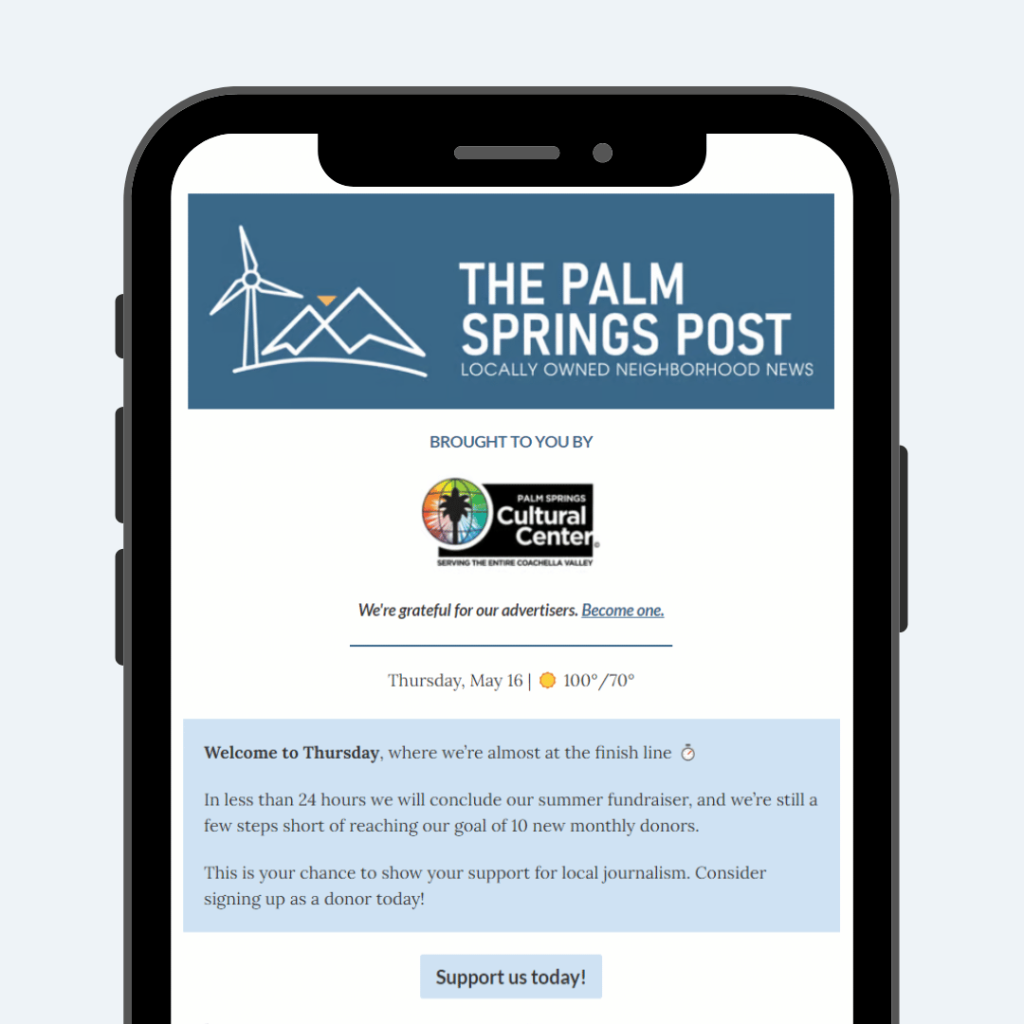
As you secure more sponsors, ad serving platforms like Indiegraf make it easy to manage creative assets and deliver ads in your newsletters. But this takes time. Don’t be discouraged if you’re not selling ad spots as quickly as you’d like. Keep at it or consider hiring someone dedicated to sponsorship to build out this revenue stream.
Other creative ways to monetize your newsletter!
As you build your newsletter’s brand, consider diversifying your revenue streams further.
- Informative or educational newsletters whose brands are built on the writer could branch into coaching calls, like Simon Owens, or a database of information, like Ariyh.
- Conversational, entertaining newsletters that have a fan following could create merch with catchphrases, or take the newsletter on the road, like Garbage Day’s live shows.
- Local newsletters could offer spaces for classifieds or public notices, like Energeticcity.ca.
As long as you keep your newsletter monetization strategies aligned with your audience’s needs, the sky’s the limit!
Read more 📖 “Email newsletters 101: A complete guide for independent publishers and journalists” to find out how to craft effective email newsletters that boost audience engagement and revenue growth.
Ready to elevate your newsletter and make it profitable? Indiegraf provides the expertise to help you navigate reader support, paywalls, advertising, and more. Transform your content into a thriving news business with us!


