In the Indiegraf webinar, “Building News Channels to Fight Misinformation and Support Hispanic Communities,” Maritza L. Félix, founder of Conecta Arizona, discussed how to build news and access to information to combat misinformation and support communities, particularly Hispanic immigrant and border communities.
As the independent outlet turns five next year, Félix reflects on how they’ve grown since launching during the COVID-19 pandemic and their impact. The team’s unique approach to community engagement and listening has been recognized across the industry, including by Press Forward, LION Publishers, and PEN America.
She emphasized the importance of challenging stereotypes, addressing bias, and ensuring the safety of her team, especially considering the diverse immigration statuses within it. The discussion also covered the different levels of community engagement on various platforms. It highlighted the value of in-person interactions.
Addressing an Information Gap in the Community
During the 2020 pandemic, misinformation spread via social media, particularly WhatsApp, was rampant. Félix’s mom, like many others, believed false information about COVID-19 prevention. This highlighted the need for accurate, Spanish-language information in Arizona, especially for Maricopa County’s large Spanish-speaking population.
“Translations from the government were so bad that having access to good information was a challenge,” she said.
“That’s why Conecta Arizona was born — to be a lifeguard for those communities at that time of need.”
Using WhatsApp and other social media, they shared fact-checked information and fostered a sense of community. “At that time, we couldn’t go out, so we were actually meeting the community where they were,” she said.
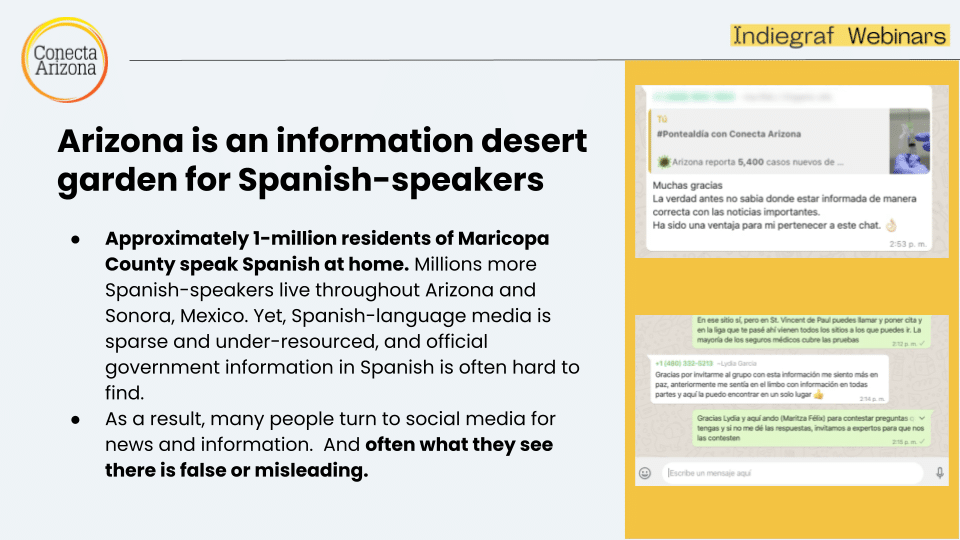
Conecta Arizona started as a journalistic experiment. It grew into a news organization with a clear mission. Its goal is to encourage important conversations and share information across border areas. It also provides news in both English and Spanish, reflecting two cultures. “The mission is to bring back those conversations that are valuable to journalism,” she said.
Building Trust with Readers
During “cafecitos” held on WhatsApp, community members can chat and ask questions directly to the expert in a safe public space without censorship. This has built trust in the community so members feel empowered to share their thoughts and concerns.
Conecta Arizona’s process is cyclical, beginning and ending with listening to the community. The organization generates conversation and produces content based on community input and needs. This approach is important for fighting misinformation and helping communities. It focuses on understanding and addressing their specific concerns and information gaps. Félix emphasizes that news organizations have often neglected this crucial aspect of listening and being accessible to community members.
The outlet views itself as a local solution to a national problem, shifting the focus of journalism from national narratives imposed locally to amplifying local stories to inform the national discourse. Many people still lack access to reliable information, particularly in Spanish-speaking and rural communities in Arizona, where Spanish-language news organizations are scarce.
Conecta Arizona aims to address this information gap and support these communities by making their voices heard, collaborating with other organizations in the region to tell their stories and counter invisibility. “But we’re just one bridge trying to [fix what] feels like a huge gap between that access to information.”
How to Listen to Your Community
“The first thing that we need to do when we’re trying to listen is to define our community,” said Félix. This could look like identifying existing service providers, potential allies, their information channels, possible partners, and local leaders. Then, determine your purpose for serving this community.
To understand our community, we need to look at how information flows. Where do they get their news? Is it from schools, leaders, HOAs, councils, churches, or organizations? We need to identify information cycles and meet community leaders, including decision-makers and entrepreneurs, not just officials.
To understand the dynamics of micro-local communities, Félix recommends attending events (online, in-person, festivals), having informal gatherings (“cafecitos”), and documenting learnings. “We actually need to have something in writing to help us to understand and digest all the learnings, then share it with the people that we’re going to be serving eventually.” After listening, ask questions and gather information through surveys, polls, or conversations to understand concerns, desires, and motivations.
After you find your community and how information flows, understand the community you want to help. Then, reconnect and keep the conversation going. Crucially, act on what you learn. “The next step after this is very important — do something,” says Félix. “Because if you’re only listening and showing up, you’re just parachuting if you don’t do something with it.”
To truly reflect community voices, challenge stereotypes (including your own biases), and examine your coverage for blind spots. Listening helps identify these and allows you to serve the community better.
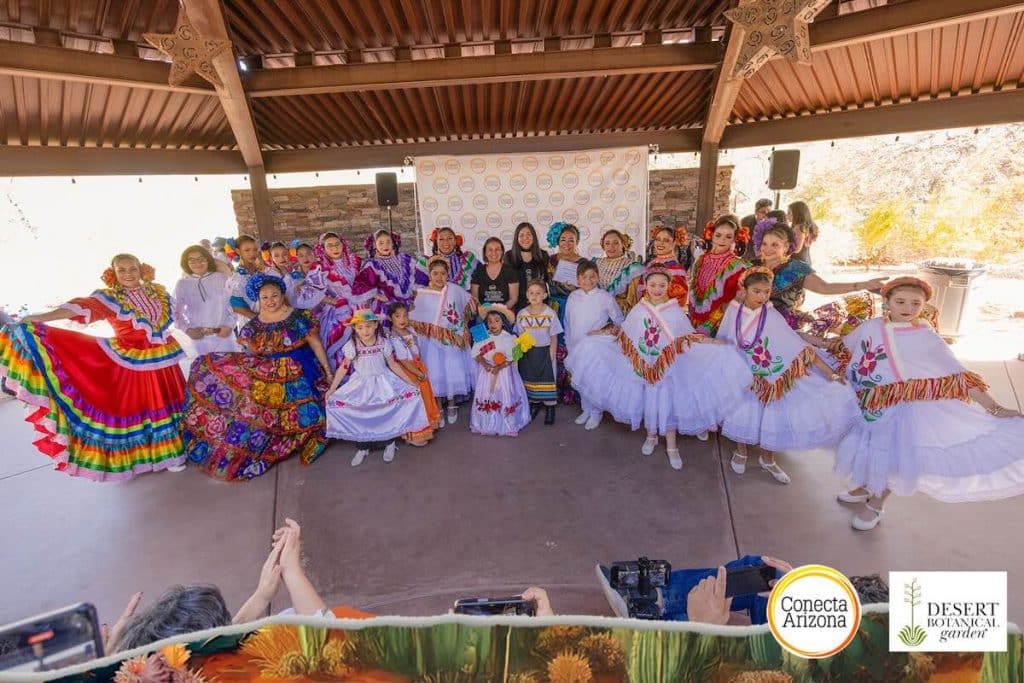
Photo via Conecta Arizona on LinkedIn