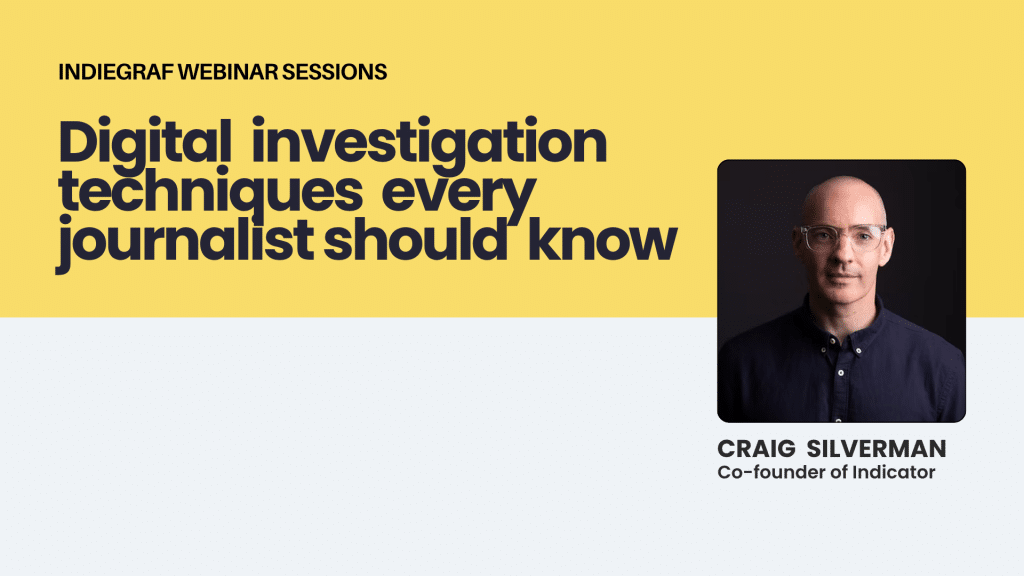
Introduction to digital investigations with Craig Silverman
No matter what kind of journalism you do or who your audience is, there are key foundational digital investigation techniques that every reporter needs to know. These skills are fundamental to producing credible, impactful work — whether you’re covering local government or community issues.
In this Indiegraf Webinar, Craig Silverman — a leading expert in online disinformation and fake news — shares practical knowledge and tools every journalist should have in their digital investigation toolkit.
Silverman is the co-founder of Indicator, a newsletter and website dedicated to exposing digital deception and equipping professionals with the knowledge and skills needed to investigate it. Previously, he worked as a national reporter for ProPublica, a nonprofit investigative newsroom, and served as the media editor at BuzzFeed News.
Digital investigative work happens on two levels
“For me, digital investigative work happens on two levels. One, observational — what we can see and what we can hear — and two, technical, which are the tools and the techniques that we might use,” says Silverman. “The thing that people overlook is often the observational piece.”
In the digital era, that mindset is more critical than ever. With so much information online — some of it misleading, manipulated, or incomplete — how you think about your approach can make all the difference in uncovering the truth.
Here are 10 key takeaways from the session that will help you verify content, trace online sources, and strengthen your reporting.
1. Your journalistic instincts are just as important as understanding how to use the tools.
Strong digital investigations rely on both observation and technical skill. Paying close attention to what you can see, read, and hear is just as important as knowing how to use digital tools. When these approaches are combined with traditional reporting — like records requests, and interviews — they lead to the most accurate findings.
Tools are always changing. Platforms evolve, features disappear, and new capabilities emerge. A thoughtful, diligent attitude paired with the right technical know-how is what leads to meaningful, effective investigations.
Read more: Revenue Streams 101: Building a Profitable News Business
2. Investigating a digital footprint begins with an account analysis.
When investigating people, companies, or organizations, it’s essential to assess their digital footprint. Reviewing social media and online accounts helps ensure you’ve done your due diligence and haven’t missed useful information. Approach this process deliberately — don’t just skim or scroll. Being strategic and thorough leads to stronger, more complete reporting.
3. Utilize the ABC framework for evaluating online accounts.
Camille François, a researcher on cyber security and digital safety, suggests the ABC framework for evaluating online accounts: look for manipulative actors, deceptive behaviours, and harmful content. Even if you don’t suspect wrongdoing, this approach helps you systematically and deliberately review accounts to ensure you’re not overlooking important information.
4. Search for other accounts using whatsmyname.app.
WhatsMyName.app is a free tool that helps users track usernames across hundreds of online platforms. By entering a known username, you can quickly identify potential accounts a person may have, speeding up what would normally be a slow, manual search.
While there’s no guarantee all results belong to the same individual, the tool makes it easier to gather leads. If you only have a person’s real name, Bellingcat offers a free tool that suggests possible usernames and searches for accounts across platforms, helping you uncover additional profiles efficiently.
5. Use assets like an email or a phone number to find linked accounts.
Email and phone number enumeration lets journalists discover online accounts linked to a specific email or phone number. By running a search through specialized platforms, you can identify potential accounts and gather information about them. Tools like Epieos can help reporters verify connections and uncover leads efficiently.
6. This free Chrome plugin helps conduct image and video analysis.
The free Chrome plugin, Fake news debunker by InVID & WeVerify, acts as a “Swiss Army knife” for image and video analysis. Once installed, it makes tasks like reverse image searches much faster. You can right-click any image in your browser and quickly run it through multiple search engines, including Google, TinEye, and Yandex.
Read more: Newsletter 101: A Complete Guide for Independent Publishers and Journalists
7. There are multiple tools available for reverse image search.
For reverse image searches, the most effective tools are Google Lens, Yandex, Bing Reverse Image Search, and TinEye. Yandex is particularly strong for face matching, while Google Lens works better for well-known individuals. Using these tools together can help uncover relevant images and information quickly and efficiently.
8. Speed up the process of getting keyframes for video analysis with this tool.
InVid’s verification plugin makes video analysis faster and easier. You can input a YouTube or public Facebook video (or upload a file), and it will automatically extract key frames. Each frame can then be opened in Google Lens or other reverse image search engines, streamlining the process.
9. Read this book for valuable tips on the process of gathering and analyzing information.
The Psychology of Intelligence Analysis by Richards J. Heuer, Jr. offers valuable lessons for journalists, emphasizing that investigation isn’t just about the conclusions you reach. It’s about being aware of how you gather and evaluate information — questioning why you focus on certain details, why you trust some sources over others, and avoiding autopilot thinking. This reflective mindset is especially important in digital investigations, helping you notice things you might otherwise overlook.
10. Follow Indicator to keep building your skills and expertise in digital investigation techniques.
Indicator, co-founded by Craig Silverman and Alexios Mantzarlis, offers original reporting, in-depth investigations, and practical tutorials to help those at the front lines of digital investigations — journalists, analysts, researchers, and trust and safety professionals — understand and investigate digital deception.
Register below to unlock the full webinar and get a special discount offer from Indicator for Indiegraf community members.