

As a fledgling news startup, every opportunity to attract new readers counts. When there’s a chance to get the publication’s name out there — whether through a newsletter swap, social media ads, or another growth tactic — it’s vital to make an impression. Embracing innovative and creative tactics in advertising can significantly amplify visibility and engagement.
Advertising agencies have long mastered the art of entertainment and persuasion. Here’s what publishers can learn from the giants on Madison Ave.
Exploring creative tactics in advertising: The art of storytelling
What is storytelling in advertising?
Many may call storytelling an art and it is one of the most common creative tactics in advertising. It is the strategic creation of narratives that resonate with audiences, evoke emotions, and inspire action.
For journalists and news publishers, storytelling is an essential tactic to engage readers and differentiate their content in a competitive landscape. By leveraging storytelling techniques, journalists can increase reader engagement and loyalty, ultimately driving the success of their publications.
Don’t just inform, entertain
Storytelling works — but have you ever wondered why? Multiple studies have shown that strong emotions strengthen memories. As Annemarie Dooling and Sam Ragland shared at the 2023 NPA Summit, “Awe is key to understanding how we can open the minds and hearts of our audiences.”
Journalists are already skilled storytellers. Now, it’s about applying that thinking to advertising. How might you write ad copy that speaks to the people you want to read your news? Or how might you design a graphic that is not only attention-grabbing but will leave a lasting impression?
Here are 5 storytelling tips for journalists inspired by the advertising industry:
- Know your audience: Just like advertisers, journalists need to understand their audience’s preferences, needs, and interests to create stories that resonate. You can even do an audience survey, here are some best practices to execute them.
- Craft compelling headlines: Draw readers in with attention-grabbing headlines that evoke curiosity or emotion, much like advertisers do with catchy taglines.
- Focus on emotion: Emotionally resonant stories are more memorable and impactful. According to Harvard Business Review, when we connect with our audience at an emotional level, the payoff can be huge. Tap into emotions like empathy, inspiration, or nostalgia to connect with readers.
- Create a strong narrative arc: Structure your stories with a clear beginning, middle, and end to keep readers engaged and invested in the narrative.
- End with a call to action: Encourage reader engagement by providing a clear call to action at the end of your story, whether it’s to share their own experiences, take action, or learn more.
Tap into your creative juices and explore how creative tactics in advertising can make an impact!
For example, Indiegraf partner publisher The Rover produced a short video announcing the outlet’s shift to Indie Tech and why readers in Quebec should support their journalism. You don’t need to create a Super Bowl-worthy ad — you just need to delight the people in the community you serve.
📰Some news: we're moving off of Substack and onto https://t.co/r63q0w6deR thanks to the good folks at @IndiegrafMedia for making this happen. For more information, consult this jingle: pic.twitter.com/solL2fdP2t
— Christopher Curtis (@titocurtis) April 28, 2023
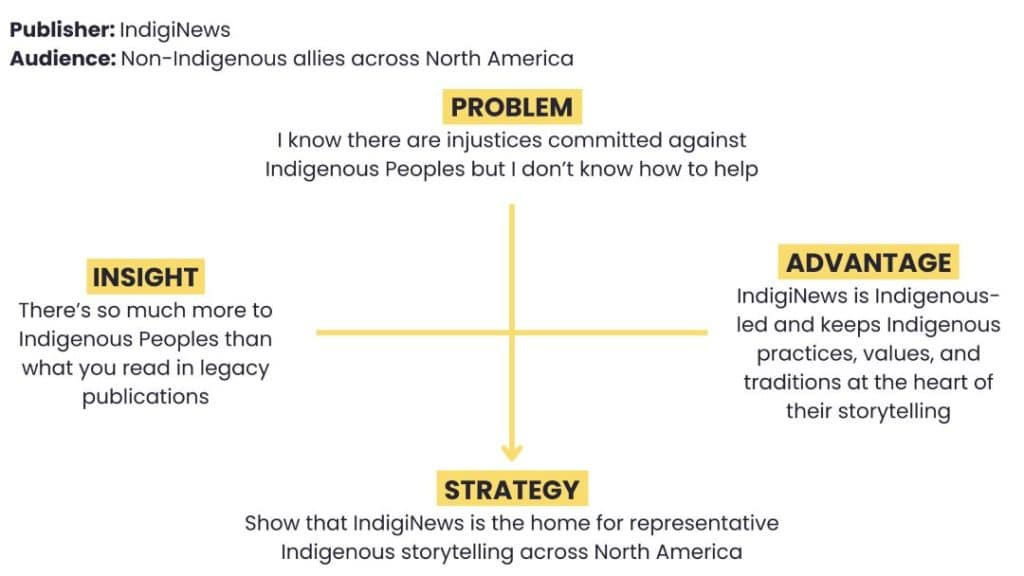
The four points framework
Use the four points framework to develop promotional strategy. This tool helps you find a common thread between your audience, the problem they’re experiencing and what your publication can uniquely offer—providing a starting point for campaign ideas.
1. Problem
First, define your audience and the problem your publication is solving for them. Does your publication fill a gap in local news? Do you produce journalism for a specific community?
For example, IndigiNews primarily wants to reach Indigenous Peoples across North America, but they have a secondary audience of non-Indigenous allies that want to learn more about Indigenous culture. For both audiences, there is a lack of Indigenous-led, Indigenous-centered journalism across North America.
2. Insight
Second, identify an “insight” — something your audience has yet to realize about the problem at hand. Insights provide valuable information that helps you tailor your messaging and approach to resonate with your audience on a more meaningful level.
For Indigenous readers, this could be that there is a place for their stories in news media, stories that are representative of their lived experiences. For allies, this could be that there is so much more to Indigenous Peoples than what legacy publications cover in their reporting.
3. Advantage
Third, clarify your publication’s unique advantage for your target audience. How does your publication address the larger problem? IndigiNews is Indigenous-led and keeps Indigenous folks at the heart of their reporting. This is exemplified in the publication of Alphonse Little Poplar’s oral histories and how the publication pursues justice for Indigenous Peoples in its series on birth alerts and police accountability.
4. Strategy
Lastly, tie the problem, insight, and advantage all together in one strategy. How does your publication show that you can solve your audience’s particular problem? From there, you can put on your creative hat and begin to entertain, keeping strategy in mind. For example, in one lead generation campaign, IndigiNews used the tagline “Our stories. Our truths.” to show that they bring a uniquely Indigenous perspective to their storytelling.
Help your readers build habits
We all know how difficult it is to start something new. The best way to encourage the adoption of a product or service is to embed usage in an existing habit.
Candy bars advertisements are a prime example. For instance, the tagline “Have a break, have a KitKat” encourages people to associate KitKats with relaxation. “You’re not you when you’re hungry” campaign plays on how filling a Snickers is, encouraging people to reach for the chocolate bar when they need a quick snack.
As a publisher, you can send newsletters in the morning so readers can browse during breakfast. Or publish podcasts just before the end of the workday so listeners can tune in on their commute home.
Make it easy for your audience to include you in their day. And if you deviate from routine — like sending out a newsletter later than usual—explain why. Be honest about being human, and you’ll develop even more loyal readers.
Want help developing strategies and creative campaigns to promote your journalism? Talk to one of our Indiegraf Experts!


